Devotional
Posted: 10/21/2026
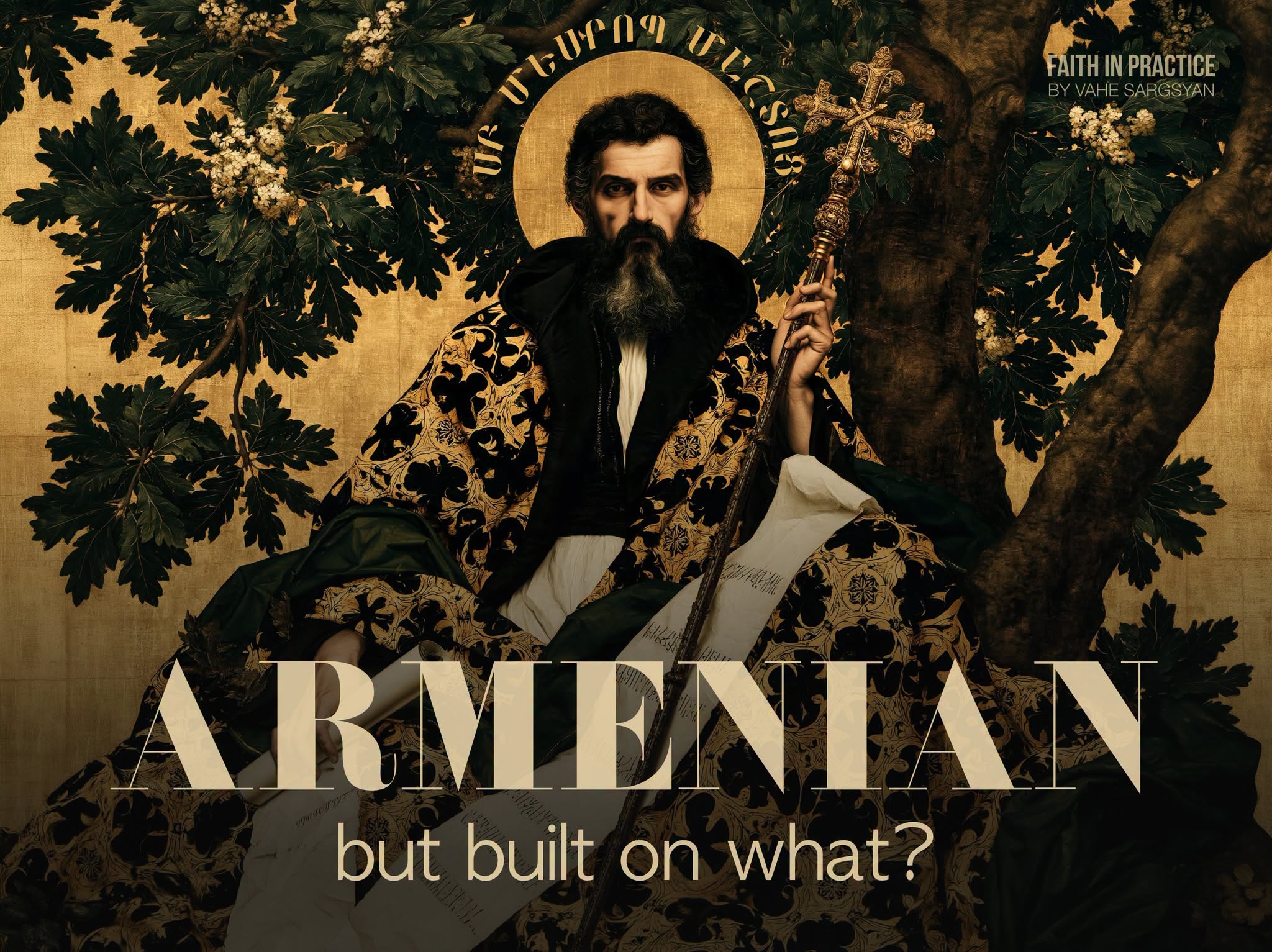
What matters more: being Armenian or being Christian?
While working on the Centennial Oral History Project, I asked that question to a young parishioner during one of our interviews. The answer came quickly: “Being Armenian.” When I asked why, she explained that we have to preserve our traditions, our language, and our heritage.
Her answer stayed with me because I have heard the same idea, directly or indirectly, many times in our communities. There is a common assumption that the first responsibility of the Armenian Church is to keep Armenians Armenian, and only after that to keep them Christian.
I believe we have the order backwards.
Language matters. Culture matters. History, tradition, and national memory matter. They are precious gifts and should be preserved. But none of them can become the foundation of the Church. The Armenian Apostolic Church does not exist primarily to preserve ethnicity. Christ gave the Church a different mission: **“Go therefore and make disciples of all the nations”** (Matthew 28:19). The mission is first to bring people to Christ. Everything else must find its proper place around Him.
St. Paul makes this even clearer when he writes, “There is neither Jew nor Greek, there is neither slave nor free, there is neither male nor female; for you are all one in Christ Jesus” (Galatians 3:28). He is not saying that Greeks stopped being Greek, Jews stopped being Jewish, or that every human distinction suddenly disappeared. St. John Chrysostom explains the verse by saying that in Christ “you have all one form and one mould, even Christ’s.” Our differences remain, but they no longer determine our ultimate worth, our salvation, or our place before God. Christ comes first.
That is why I would argue that if you want to become the best Armenian you can be—or the best Greek, American, Armenian-American, or anything else—you must first become a faithful Christian. Christianity does not make you less Armenian. It teaches you how to be Armenian without turning your nationality into an idol. It teaches you truth, courage, sacrifice, humility, love, faithfulness, and responsibility. Those virtues then shape the way you serve your family, your community, your culture, and your nation.
Our own history proves this.
When St. Mesrop Mashtots created the Armenian alphabet, the great achievement was not simply that Armenians now had their own letters. The alphabet immediately became a means of bringing Scripture and Christian teaching into the Armenian language. St. Koryun, the disciple and biographer of Mashtots, describes the result beautifully: “At that time our blessed and wonderful land of Armenia became truly worthy of admiration, where by the hands of two colleagues, suddenly, in an instant, Moses, the law-giver, along with the order of the prophets, energetic Paul with the entire phalanx of the apostles, along with Christ’s world-sustaining gospel, became Armenian-speaking.”
Notice what happened. Christianity was not placed in the service of Armenian identity. Armenian language was placed in the service of the Gospel. And because of that, both flourished.
The Scriptures became Armenian-speaking. Theology became Armenian-speaking. Prayer became Armenian-speaking. Schools, manuscripts, literature, music, art, and learning grew around that Christian foundation. Our faith did not weaken Armenian culture. It gave Armenian culture one of its greatest periods of creativity and intellectual life.
This is also why St. Irenaeus could say of the universal Church that, although “the languages of the world are dissimilar, yet the import of the tradition is one and the same.” Christianity does not demand that every people become culturally identical. The Gospel can be preached in Armenian, Greek, Arabic, English, or any other language. The languages are different, but Christ is the same.
That is the proper relationship between faith and culture. Christianity does not destroy what is good in a culture. It judges it, purifies it, strengthens it, and gives it direction. Whatever is true, beautiful, courageous, and worthy can be preserved. Whatever contradicts Christ must be corrected, no matter how old or familiar it may be.
The danger begins when we reverse that relationship and ask the Church to serve our ethnicity instead of asking our ethnicity to serve Christ. Then baptism becomes a cultural ceremony. The Divine Liturgy becomes heritage. The church building becomes a community center with an altar. Christianity becomes something we use to prove that we are Armenian rather than the faith by which we learn how to live.
And eventually the foundation begins to weaken.
Traditions alone cannot unite us. Language alone cannot unite us; many Armenians no longer speak Armenian. Geography cannot unite us; we are scattered across the world. Politics certainly does not unite us. Even our ideas about what it means to be Armenian often divide us.
But Christ can unite people who otherwise have very little in common.
St. Paul reminds us, “For our citizenship is in heaven” (Philippians 3:20). That does not mean we stop loving Armenia, our language, or our heritage. It means we know where our deepest loyalty belongs. Once that foundation is secure, everything else finds its proper place.
Our ancestors did not preserve Christianity because it was useful for keeping Armenian identity alive. Armenian identity survived in large part because generations before us built their lives around Christianity.
The root came first. The fruit followed.
If we want the fruit to survive, we cannot cut it away from the root.
The Armenian Church should certainly preserve our language, history, sacred music, traditions, and memory. But its first responsibility must always remain what it has always been: to bring us to Christ, to form us in His Gospel, and to lead us toward salvation.
Because the strongest Armenian identity is not one that replaces Christ with ethnicity.
It is one that grows from Him.
